Junk or Jank?

by Steve Giannopoulos

The new Standard has arrived and with it many brewing options. A lot of big mana strategies seem to be the thing and the aggro strategies seem to be relegated to Zombies, WG Aggro and Mono Red.

Mono Red is always the kind of deck that thrives at the beginning of a format and has pretty much no late game to speak of. Cards like Vexing Devils kind of just hit play and sit there staring at bigger dudes not doing much but probably chumping. You can always rip a Thunderous Wrath and randomly win but that’s sort of like relying on luck a weee but much for my taste.

I was personally inclined to the play a Green-based Aggro deck with Rancors as they seem rather well-placed in the current metagame. I called a friend and asked him for his decklist for the upcoming Grand Prix Trial the day before. He was kind enough to provide me with one:
JUNK by Xavier Biron

Creatures
4 x Arbor Elf

4 x Avacyn’s Pilgrim

4 x Strangleroot Geist

4 x Loxodon Smiter

4 x Dreg Mangler

2 x Deadbridge Goliath

3 x Disciple of Bolas

2 x Sigarda, Host of Herons

Spells
3 x Rancor

4 x Abrupt Decay

2 x Tragic Slip

2 x Sever the Bloodline

Lands

4 x Overgrown Tomb

4 x Temple Garden

3 x Isolated Chapel

1 x Sunpetal Grove

1 x Woodland Cemetary

2 x Gavony Township

1 x Vault of the Archangel

1 x Swamp

1 x Plains

4 x Forest

Sideboard
2 x Crushing Vines

2  x Thragtusk

2 x Ray of Revelation

1 x Sever the Bloodline

2 x Tragic Slip

1 x Sigarda, Host of Herons

3 x Knight of Glory

2 x Rest in Peace

You might recognize the deck designer’s name. He recently got in the Pro Tour and will be going to Seattle to battle it out with some of the world’s best players. He won a Pro Tour Qualifier with a Green/Blue Infect deck. It was a somewhat rogue deck and caught a few people by surprise. He usually has a good understanding of the metagame and can back up a lot of his card choices by indicating a lot of situations in which they would be better than the cards that are usually played or proposed to him.

The Junk deck above is not exactly revolutionary, but it is somewhat unusual. You will notice that the color white is very minorly represented in the list but it does pack quite a punch.

Sigarda, Host of Herons

This little angel has become increasingly better for a few reasons. The main one being that 2 out of 3 monoblue clones just hit the curb with the arrival of the new Standard format. Incidentally, this was a big reason Olivia Voldaren was held back for quite some time. The only option now for clone shenanigans is Clone or Evil Twin. At the moment, they are suboptimal, but you never know…


Remember these guys?

She invalidates Liliana of the Veil’s -2 ability as well as making Killing Wave, Barter in Blood, Tribute to Hunger and targeted removal utterly bad. She is definitely a good target to slap a Rancor on. There’s not much slowing her down save mass removal or a bigger angel like Angel of Serenity, which is seeing some play.

Loxodon Smiter

This bad boy makes Liliana of the Veil’s +1 rather risky. Often compared to Obstinate Baloth minus the lifegain, this guy is a lot more relevant as he comes down a turn earlier AND cannot be countered. It almost seems like the ‘cannot be countered’ cycle came out a set too late. With Mana Leak no longer in the format and Syncopate not nearly as effective, a lot of decks can afford to play less carefully around counters. It also helps that the control decks start to shape up more after the aggro ones do, since you obviously need to know what you need answers to. The best answer in this case is Mizzium Mortars, which incidentally is also the answer a lot of times your opponent ‘Miracles’ Entreat the Angels on his upkeep. Early on this guy just goes through unmolested against most decks and he is sizeable enough to play with the big boys later on. As a side note, I believe he is probably a very valid addition a Maverick-style Sideboard in Legacy, but most probably more in Modern. He punishes Jund’s discard and steers clear of the Lightning Bolts. this is similar to Obstinate Baloth of course, but the Smiter feels more Maindeck-worthy.

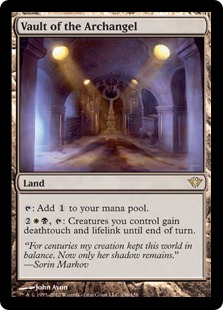
Gavony Township and Vault of the Archangels


The Township has been gaining popularity as of late. The only real risk in activating it is put a counter on Strangleroot Geist and not being able to bring it back after a Supreme Verdict or the like. It definitely gives your mana dorks (Avacyn’s Pilgrim and Arbor Elf) some value in the mid to late game. It can also fatten up one of your creatures to sacrifice to Disciple of Bolas and get a pretty massive card draw and lifegain advantage.

The Vault offers somewhat different benefits. It allows your little dorks to trade with bigger creatures, thus warding off some aggro at times. Also, it’s really great with Strangleroot Geists since you have no qualms about trading them against other creatures and having them come back for a repeat performance. In mirror-matches (well, kind of . ie: Zombies and GW aggro) it can present a real dilemma to your opponent when he is trying to decide how to attack and not incur a major life swing  in the process. You would activate it on after blockers are declared to make some unfair trades and then on your turn when you hit him back for more life.

The Scavengers

Deadbridge Goliath and Dreg Mangler are really well-costed for their size. Not only that, but they allow you to recover pretty well post-board whipe. Everything went boom and you just drew an Avacyn’s  Pilgrim? No problem! just play that bad boy and ‘equip’ him with some +1/+1 counters courtesy of the Scavenge mechanic. As a side note, don’t forget that they can also add +1/+1 counters to an Unleash creature and make it unable to block. This is really marginal, but probably an interaction people should be aware of (mostly in limited).

The Goliath is Blastoderm-sized and probably slightly better than even Blastoderm would be these days. Sure he isn’t Hexproof or Shroud, but he does provide an advantage after his untimely demise. Blastoderm would probably just 2 for 1 a couple of creatures which is ok in the current Standard. Goliath can do the same or eat a removal and probably force another removal when scavenged. The difference is that the Goliath stays in play much much longer and is better if Counterspelled (also probably a reason why it’s a Rare).

Dreg Mangler is basically Strangleroot Geists # 5 through 8. Again, with some added value if they are Countered or milled (unless of course, if they get Dissipated or Syncopated). Just like pretty much most of the aggressive creatures, it’s really good with Rancor. 5/3 trample haste? Yep! Sign me up!

Card Advantage?

Yes, there are many forms of it. The more direct advantage comes from recurring Rancors and drawing cards off of Disciple of Bolas. Disciple is so good in this deck since you can probably recoup the things you sacrifice. Sacrifice a Rancored Deadbridge Goliath, get Rancor back to your hand and scavenge the Goliath later on. Did I mention this thing is the Release Party card? I would probably get a playset on the cheap at the moment as they are probably undervalued.

Removal? in Spades!

Tragic Slip continues to be good in this metagame. It kills early game accelerators (Pilgrim Arbor Elf) and also is a card that deals with Falkenrath Aristocrats. Obviously, you can get more value out of it when you trigger its Morbid ability, since it can kill other nuisances such as Lotleth Troll and Wolfir Avengers.
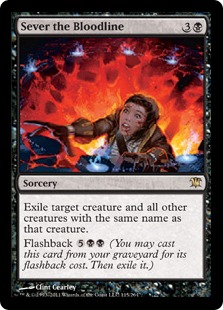
Sever the Bloodline was somewhat hyped for a small time during the past Standard season but never really saw play. Now with the absence of Doom Blades and Go For the Throats, it is much much better. Add to that the fact that it removes the creature, so it’s an ideal removal for Geralf’s Messengers and other Zombies. In other cases, it will just board-whipe tokens, namely Entreat the Angels tokens. The fact that it has flashback is rather nice, since control decks can cast it after having dumped it in the grave with Forbidden Alchemy later in the game.

Abrupt Decay is somewhat pricey at the moment with good reason. In the current environment it can really kill way to many things. Oblivion Rings, Keyrunes, some Planeswalkers, tokens, Detention Spheres and the list goes on. The fact that it cannot be countered simply adds to its goodness. It seems to be a good future staple in formats that are more mana-efficient as you can deal with more permanents. It’s also quite better than Murder, since using your turn 3 to cast a Murder is not quite what you want to be doing in a mostly aggressive deck (unless your turn 1 was a Pilgrim and turn 2 was a Loxodon Smiter, of course).

Sideboard

This sideboard is basically an anti-graveyard, anti-aggro one. Also, as the Knight of Glory indicates, we are prepared for a heavy black metagame. Crushing Vines versus Angels mostly and perhaps the odd artifact here and there as Scars Block has come and gone. Ray of Revelation do a great job against Oblivion Rings and Detention Spheres.

More removal follows, just in case you are not always the aggressor.

Value is now harder to spell… T h r a g t u s k

Thragtusk is just overall good, so why not? Also, he is a great ‘target’ for Disciple of Bolas.

This covers our small trip to Ravnica Standard for today. Stay tuned for further decks and articles!


Real Steel

by Steve ‘DDT’ Giannopoulos

Well, Return to Ravnica is soon upon us and it will be pushing out a Scars of Mirrodin Block from Standard. Lots of the older Magic: the Gathering players are happy to greet this new set as they have great memories from the original Ravnica block. Not too many people are concocting any new Standard decks in the current metagame now, but I always try to play a few rogue-ish decks in the final weeks of a month were a block will rotate.

I was never a huge fan of the Mirrodin artifact theme personally. It took a lot of color-specific abilities and put them on artifacts, thus negating the color-commitment aspect. I did eventually slowly got over that and think they did a great job with the artifact theme this time around. One thing that I think most people didn’t fully exploit in Constructed was the Living Weapon ability. It basically allowed some of your equipment to come into play pre-equipped, while not allowing you to do much else with the Germ token.

The deck we will be examining today makes fine use of these equipments and I believe positions itself pretty well in the current Standard environment (for however long it has left). On the plus side, if you decide to build this deck, acquiring the necessary cards should not be a huge problem as they are almost all from the old block (Scars). In addition, I believe this is a deck you can keep sleeved up and play many casual games with for a long time to come.

Here’s the decklist:

Real Steel

Lands

4 x Cavern of Souls

4 x Glacial Fortress

4 x Inkmoth Nexus

1 x Moorland Haunt

6 x Plains

4 x Seachrome Coast

Creatures

2 x Etched Champion

2 x Glint Hawk

2 x Grand Abolisher

2 x Mirran Crusader

1 x Phyrexian Metamorph

4 x Puresteel Paladin

2 x Spellskite

3 x Trinket Mage

Artifacts

1 x Accorder’s Shield

1 x Batterskull

4 x Flayer Husk

1 x Grafdigger’s Cage

3 x Mortarpod

1 x Silver-Inlaid Dagger

4 x Sword of War and Peace

1 x Sylvok Lifestaff

Other Spells

3 x Dispatch

Sideboard

1 x Celestial Purge

1 x Dispense Justice

1 x Divine Offering

2 x Leoning Relic-Warder

2 x Mental Misstep

2 x Mirran Crusader

2 x Oblivion Ring

1 x Snapcaster Mage

1 x Spellskite

2 x Sword of Feast and Famine

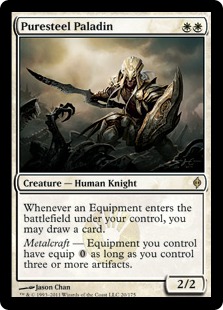
The first thing you will probably notice is that Puresteel Paladin plays a key role in the deck. In fact, you can pretty much say that he is at the heart of the deck. He pretty much gives all your equipment extra value and makes it extremely easy to attack safely with swords and then re-equip them for free to be able to defend  against whatever counterattack your opponent might have planned.

Don’t get me wrong, I’ve won many games without ever having drawn a Puresteel Paladin. It’s just that it requires much more effort. On top of it, the effect is cumulative. This means that if you happen to have two Paladins in play, you will draw 2 cards per equipment that hits the battlefield.

Let’s give the deck a more in-depth examination:

Lands

We have our basic dual configuration: the 4 Scars of Mirrodin duals and the 4 M13 Duals. Not too costly and definitely needed.

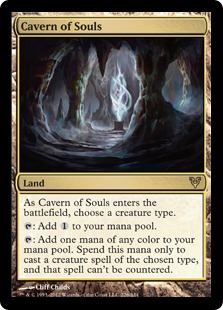
Next up we have 4 Cavern of Souls. Now these are somewhat costly, but they should be viewed as an investment for anyone planning to play Standard or any kind of tribal deck. They make sure the majority of creatures in our deck do not get countered. Yes, humans again! Sometimes you might want to name Soldier so your Etched Champion comes down equips a bunch of stuff and goes for the throat.

It also does wonders with Grand Abolisher. You land a creature that can’t be countered that will make it so that all your other spells will not get countered.

Inmoth Nexus makes an appearance in this deck as a great utility card. Be it giving you Metalcraft or swinging with a few equipments on it, it plays its part well. Post Day of Judgment, it will either be chump blocking if your opponent recovers before you or attacking for 1 or 2 infect and giving you a slow but steady win condition. You can activate its ability to allow your Etched Champion to survive a Slagstorm or something like a doom blade.

The lone Moorland Haunt allows you to make more dudes at the end of your opponent’s turn and start equipping them and attacking on your turn. You realy don’t want this and Inkmoth Nexus in your opening hand as your only mana sources as you often times need at least 2 white mana to cast most of your nonartifact creatures.

Creatures

You obviously run 4 Puresteel Paladin here. He screams ‘build around me’ and he is always an affordable card. If you have to decide what needs to be equipped, make him your number 1 option. He will affect the board more than any of your other guys.

This deck uses a long-time favorite (Trinket Mage) extremely well. He fetches you a Zombie/ Birthing Pod hate card in Grafdigger’s Cage. Aside from that, he can get you a Sylvok Lifestaff in order to gain some life and stand a better chance in the late game. The staff will combo really well with Mortarpod. You shoot a creature for 1 while gaining 3 life, at the small cost of a Germ Token. Remember that you can also do the same with Inkmoth Nexus which will cause infect damage. This can be a great way to close out a game with a final 1 or 2 points of infect.

Trinket Mage can also fetch a chump blocker in Flayer Husk allowing you to spam the field and have a better mid to late game. He can also double block with the token to kill a 3-toughness attacker if needed. However, if you are trying to press your advantage, I believe the best option is Silver-Inlaid Dagger. This little knife will give almost any creature in your deck a +3 attack bonus. Keep in mind that even the base + 2 attack is pretty nice also, especially when equipped to an Inkmoth Nexus.

Usually reserved for White Weenie decks, I believe Grand Abolisher does an awesome job in this deck. It allows your equips to go uninterrupted and prevents nasty surprises on your opponent’s side (Restoration Angel). You just don’t want to see him too often, which is why we run only 2.

The previous statement holds true for Mirran Crusader. He’s usually a powerhouse against a lot of decks or even just when regularly equipped. There are however many decks against which he is not so hot. Games with him can end quickly if you are facing something like a Green/White deck and he is equipped with a Sword of War and Peace.

Etched Champion is your big bruiser. He may not seem like much, but he does pack quite a punch. When facing down against Wolfir Silverheart –enhanced creatures, you will be glad he is on your side. Metalcraft should never really be a problem and as mentioned earlier, you can always activate an Inkmoth Nexus if you need to protect your Champion. The main problem he has is playing defense versus a Rancored creature. That can become a huge problem really quickly.

Glint Hawk and Phyrexian Metamorph provide a nice little overall utility for the deck. Obviously we all know how awesome Metamorph is. Wether it’s killing a legend, doubling up a busted equipment or simply another copy of Etched Champion, he’s doing something useful.

The little Hawk on the other hand, is used mostly to reset living weapons or sometimes bounce back a Champion to give it pseudo vigilance. Oftentimes, you will even be bouncing back any equipment to your hand in order to replay it and draw a new card off of Puresteel Paladin. He can also fly over a stalled field and chip in to provide a few points of damage. There are also instances in which he will be equipped with a Sword of War and Peace in order to indefinitely hold off a Restoration Angel. These are good times!

Other Spells

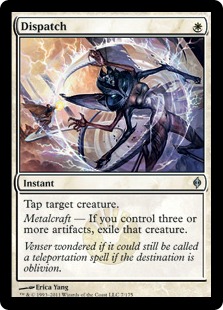
This section is rather brief since we only run 3 Dispatches. This means we need to use them conservatively. If the creature you dispatch is in no way hindering your path to victory, it was a bad move. You usually want to use it on a Primeval Titan that will clearly become a problem. The same goes for Talrand, Sky Summoner. Again, use your judgment and avoid liberal uses of Dispatch.

Another small warning about this spell is that it it’s almost always cast with Metalcraft. Metalcraft is also checked on resolution, so be sure to have an Inkmoth Nexus ready to respond when your opponent busts one of your artifacts to make Dispatch lose its Metalcraft effect. You want to probably do it when you have 4 or more artifacts just to be sure.

Artifacts

Pretty much all equipments here except for the lone Grafdigger’s Cage.

We can afford to have a maindeck Cage here as our Trinket Mages can make sure we can find it when needed. One copy is more than enough, since we really do not want this in our opening hand.  It does a great job versus Snapcaster Mage, Zombies and Birthing Pod.

The lone Batterskull is just awesome in this deck. You can easily play it, equip it for 0 due to Puresteel Paladin’s ability and beat down your opponent while gaining life. Then comes the great part: you can re-equip the Batterskull on Puresteel Paladin afterwards in order to protect him from something like a burn spell, Black Sun’s Zenith or Mutilate. If you are digging for something like a Mortarpod or Dispatch, you can also always bounce the Batterskull back to your hand and replay it so you can draw a card off the Paladin.

Flayers Husks are the little drones of the deck. They get played early on, get a few points of damage in, die, get equipped and then enable Metalcraft. A nice little life for a 1-cost equipment,no?. Oh, I even forgot to mention: draw a card. Well, most of the time. Your opponent will almost never want to trade his 1/1’s with a Flayer Husk, so don’t be shy and attack him when you can.

A small amount of the deck’s removal also comes from Mortarpod. This mini-removal can be very effective as there are quite a few little creatures in the format. You will often be needing to take down things that have more than 1 toughness with it. That’s also where the Puresteel 0-cost equip ability comes into play. A word to the wise: use it almost immediately on a Blade Splicer. You don’t want to get greedy and keep the Germ Token to block an attacker and then try to kill the Blade Splicer. This will almost always be met with a Restoration Angel flash in response and you will be losing all sorts of ‘value’ because you opted to be greedy. It’s bad enough you didn’t kill a 1/1 token producer, now it’s back and it brought back a little friend.

The big difference making equipment in this deck is Sword of War and Peace. A lot of decks out there play white, making the protection very relevant. The life gain/burn ability gets out of hand quickly and can end the game in a flash. Although less decks are playing red creatures, but keep in mind that it will protect your equipped creature from something like a Bonfire of the Damned. It’s a hugely popular card right now and very effective. So slap your sword on the creature you value most.

Accorder’s Shield may not look like much but it does a few decent things for its 0 cost. It can be fetched by Trinket Mage and played immediately, usually drawing you a card off of Puresteel Paladin. It also give your creature vigilance, which is pretty insane with Etched Champions. It allows them to play both sides of the field and eventually win the game. The extra 3 toughness is hardly a laughing matter either. It makes even the lowliest creature useful on defense. You can even pretend you are swinging with a mini-Serra Angel when attacking your opponent with Glint Hawk.

The other two one-ofs were pretty much covered before. They are both retrievable with Trinket Mage and each fills a completely different role. Go get Silver-Inlaid Dagger if you are going on offense. Alternatively, go fetch Sylvok Lifestaff if you need the lifegain, or if you want to do Lifestaff/Mortapod shenanigans.

Sideboard

This sideboard is somewhat metagamed but I think it’s reasonably flexible. You don’t absolutely need a Snapcaster Mage in there, but he is rather good if you are planning on siding in the Instants. He’s also uncounterable with Cavern and another body you can remove to make a spirit token with Moorland Haunt. Other than that, I would maybe tweek it a little more to combat Curse of Death’s Hold. That is a huge card against this deck. The few games I have lost with this deck can be attributed to 1-2 copies of that card in play. When there are two copies, the Leonin Relic-Warder should be good to permanently exile one of them.

You cast the Relic-Warder. If he is not countered, he will enter the battlefield. Once on the battlefield, his come into play ability will go on the stack, however state-based effects will be checked and see that he is a 0/0 and thus dies. This will cause his leave the battlefield ability to go on the stack. The stack will resolve in a last-in/first-out order. The leave play ability resolves, doing pretty much nothing. Then the enter the battlefield ability resolves, removing the Curse forever and ever. It’s a neat little trick that is good to know, since aside from Oblivion Ring and Celestial Purge, is one of the only outs you have in that situation.

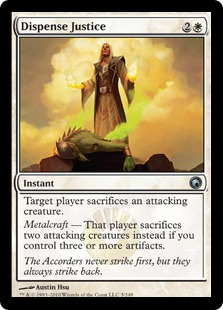
I would like to experiment more and see what the optimal number of Dispense Justices is. The environment is pretty aggressive right now. Anytime you can get a two-for-one out of this bad boy is just great.

You will usually swap out Swords of War and Peace for Swords of Feast and Famine if you are facing a deck that has anything Green or Black in it. I believe it needs to be stated even if it seems obvious to a lot of you.  Other commonly sided out cards are: Glint Hawk, 1 x Mortarpod, Flayer Husk, Grafdigger’s Cage and 1-2 x Trinket Mage. You always want to keep the core engine running in almost all situations. There are some really rare times you will want to take out the Dispatches. A good example is if your opponent is playing a version of the UW Hallelujah deck not aware that it was a Block deck and not a Standard deck. It happens more often than you think, since a lot of people will just do a straight port instead of adding in the non-block stuff.

That wraps it up for today. I will try to write more articles on a more regular basis.

Commander’s Arsenal

These contents seem very commander-like.

Oversized Commanders. Check!

-/+ counters. Check!

Sleek sleeves. Check!

FOILY staple cards. Check!

Exclusive life counter. Check? woah!

Pretty epic, huh?

Value?

Definitely Check!

Full contents:

  • 18 premium foil cards
  • 10 oversized premium foil cards
  • 120 UltraPRO foil card sleeves
  • 20 double-sided Battle Marks (+ and –)
  • A life counter that goes up to 99

These are sure to go fast, so make sure to grab them when you can at your local card store.